
Pelvic Floor Basics
The pelvic floor is often talked about but also often misunderstood. There’s good reason for this – it’s a tricky part of the body to explain clearly and to demonstrate visually. It's mentioned in physio referrals, postnatal check-ups, continence ads and social media reels but exactly is the pelvic floor?
This page is where we slow down and try to make it clearer to understand. We'll walk through what the pelvic floor actually is, where it sits in the body, and what it does every single day without you noticing — from holding in urine and stool, to supporting sex, pregnancy, birth and recovery, to quietly managing pressure every time you cough, laugh or lift something heavy.
Whether you're a clinician looking for a clear reference, an educator sourcing accurate language, or simply someone who wants to understand the body a little better, you're in the right place. And because pelvic anatomy is naturally diverse, what follows is intended to reflect that range. Our intention is always to acknowledge that each and every person is different and there is variation in all bodies.
Cliterate Pelvic Floor Muscles
We are excited to share a project we have been working on in the background. The Pelvic Floor Muscle Kit has come to life after hours of consultation with healthcare professionals and educators who frequently have conversation about pelvic muscle function with patients, clients and students. We are immensely grateful to this consulting community and truly hope this addition to the model fills a gap in educational resources available in healthcare and education settings.
Here’s a short video explaining how to pull apart the Cliterate model and use the Pelvic Floor Muscle insert
How to use the Pelvic Floor Muscle Kit with your Cliterate model
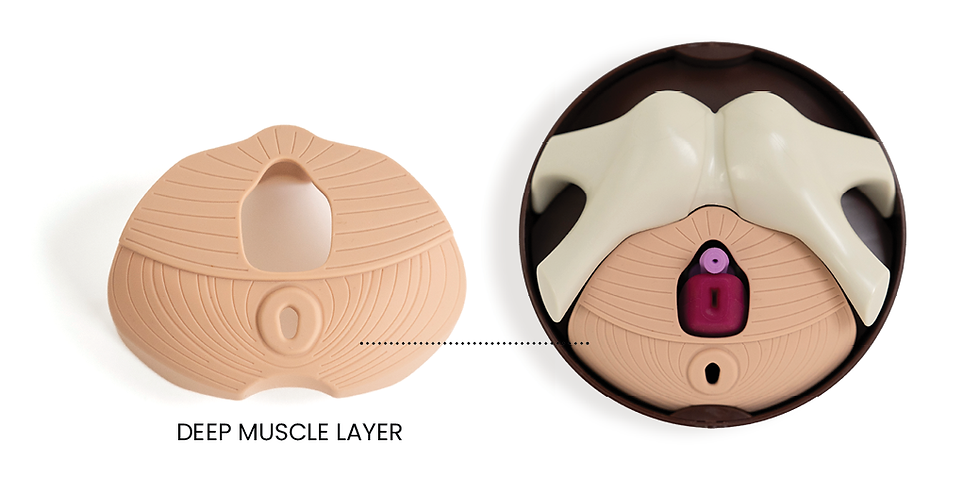
Deep muscle layer
Remove the clitoris from the model, then insert the deep muscle layer as shown.
Superficial muscle layer
Place the clitoris back into the model and insert the superficial muscle layer over the clitoral glands to rest on the clitoral body. Click the base of the superficial anal sphincter into the deep muscle layer.

Darker inner labia
Insert the darker inner labia. This labia is required when using the pelvic floor muscles inserts.
Note: To demonstrate the use of swabs and catheters, remove the vagina and urethra pieces to create negative space.


Anatomy Basics
Let's start with the basics — what is the pelvic floor and where exactly does it sit in the body? Understanding the structure first makes everything that follows (why tone matters, how practitioners use the model) click into place
Pelvic bones
The pelvis is a sturdy, bowl-shaped ring of bones at the base of the spine. It connects your legs to your body and protects your internal organs.
Pelvic floor muscles
The pelvic floor muscles are a group (or sling) of muscles that stretch from the pubic bone at the front of the pelvis to the tailbone at the back, and side to side, forming a hammock-like structure. See the two layers below:
Superficial muscle layer
Closest to the skin which has a role maintaining continence and sexual function.
Deep muscle layer
Supports the pelvic organs – the bladder, bowel and uterus (when present) also assisting in maintaining continence.

Functional Basics
Next we will explore some answers to a commonly asked question: what’s the function of pelvic floor muscles in the body?
-
Function at rest - the muscles work together to keep a gentle level of tension (tone) to support organs and manage gravity throughout the day
-
Continence — they help to hold in pee and poo. Ring muscles (sphincters) around the urethra and anus squeeze closed to stop leaks. There are no ring muscles around the vaginal opening, which is why menstrual blood can’t be held in.
-
Organ support — the help hold the bladder, bowel, and uterus (if present) in place.
-
Sexual functioning — support comfort and sensation during sexual activity.
-
Automatic response — the muscles work automatically, responding to pressure changes to help absorb shock during coughing, laughing, jumping or lifting.